The personal blog of Stephen Jones (We have moved. Please visit "Pinch of Clay" for my latest posts)
Tuesday, February 22, 2011
Herod who??
Well, so much for simplicity. Even this chart looks more like an engineering schematic than a family tree. To boil it all down, there are four key members of Herod's family mentioned in the Gospels...
Herod the Great. This is the original Herod of them all. The very name sent shivers up the spine of ancient Jews. Son of Antipater, he was a cunning politician, ruthless dictator, and brilliant architect. He was responsible for constructing the temple mount in Jerusalem, fortress palaces at Herodium and Masada, and a harbor at Caesarea -- all which continue to astound archaeologists and engineers today. In addition to killing several kin who threatened his throne, Herod murdered all the young boys in Bethlehem at the news that a baby king named Jesus had been born (Mt. 2:16). Herod died a short time later, splitting his kingdom between three sons.
Herod Philip - son of Herod the Great through his wife Cleopatra. Ruled over a vast area of NE Palestine until AD 34. The city of Caesarea Philippi up in the foothills gets its name from this man.
Herod Antipas - son of Herod the Great through his wife Malthace. Ruled over Galilee and Perea until AD 39. Antipas is the one who stole Herodias from another half-brother named Philip (Mt. 14:3) and was responsible for executing John the Baptist (Mt. 14:10). He's also the Herod who appears during the Roman trial of Jesus (Lk. 23:7).
Archelaus - Another son of Herod the Great through his wife Malthace. A vicious and inept king who ruled for about a decade over Judea and Samaria, but was de-throned while Jesus was still a child (he is mentioned only in Mt. 2:22). By the time Jesus began His public ministry, this region had long been taken away from Herodian control and assigned to Roman procurators/governors.
There are even more descendants of Herod mentioned in the book of Acts, but I won't take time to discuss them now. Here's a map from the Holman Bible Atlas showing the political boundaries right after Herod the Great's death. This is how Israel looked when Jesus' family returned from Egypt and settled up in Nazareth.
Wednesday, November 10, 2010
True treasure
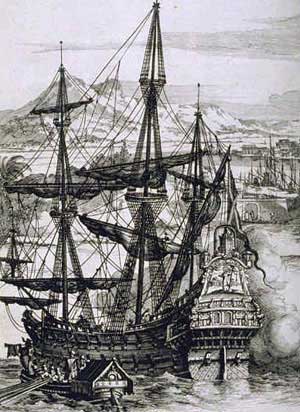
For sixteen long years, using state of the art equipment, Fisher scoured the ocean floor for any sign of the ship. Finally, on July 20, 1985, his son Kane announced, “Put away the charts; we’ve found the main pile!” Their find was dubbed the “shipwreck of the century,” worth hundreds of millions of dollars, and has been compared to the discovery of King Tut’s tomb.
Did you know you, too, could strike it rich? I’m not talking about the lottery. The Bible says “Happy is a man who finds wisdom…for she [wisdom] is more profitable than silver, and her revenue is better than gold. She is more precious than jewels; nothing you desire compares with her” (Proverbs 3:13-15). Find wisdom, and you’ve hit the real jackpot.
Wisdom is the ability to make good and godly choices in life. It’s more than just an IQ. Wisdom is an attraction to everything good, and true, and beautiful. It is not driven by emotions. It carefully weighs each option. It acts responsibly. It thinks about long-term consequences. It is street-wise in a dangerous and confusing world. Imagine how different things would be if we all spoke and acted with wisdom!
So, how do we find wisdom? Proverbs 9:10 provides the treasure map: “The fear of the LORD is the beginning of wisdom, and the knowledge of the Holy One is insight.” To gain wisdom we must first develop a healthy fear and respect for the living God.
This means we must recognize that God alone is pure and powerful, able to tell us how life works. We must admit our own sense of direction is faulty. We must believe God’s Word is more reliable than our closest friend, our smartest professor, or our favorite talk show host. We must accept that Jesus alone can rescue us from our sin, for “in Him are hidden all the treasures of wisdom and knowledge” (Colossians 2:3).
True wisdom begins with the fear of the Lord. And the fear of the Lord begins with knowing Christ. Only then can we become truly rich. Even richer than Mel Fisher.
This article was written for publication in today's edition of our local paper, the Hi Desert Star.
Thursday, December 10, 2009
Photos of Bible manners and customs
The Traditional Life and Customs photos...have long defined the entire [American Colony photo] collection for me. When someone would ask what I was working on, I'd smile and tell them about the photos in this set. If nothing else, the American Colony collection had to see the light of day because these were photos that I could never take myself, in any shape or form. With Jerusalem, you can still get a photo of the Kidron Valley, even if it is covered with buildings. But the only fishermen I see today on the Sea of Galilee are in motorboats and they are wearing plastic green coveralls. I have trouble imagining Jesus and the disciples with this picture.
Shepherds still roam the Judean hills with their flocks, but I hesitate to include them in any photo because they're wearing a windbreaker and Levis. The grain harvest usually includes a combine, and cooking is over an electric stove. When a locust plague threatens, the authorities are quick to react to prevent the insects from devouring the crops. That's good for the farmers, but bad for the photographers. This new volume has all of this and much more...
Just what does Traditional Life and Customs include?
Agricultural Life: Plowing, Sowing, Water, Vineyards, Locust Plague, Grain Harvest and Olive Harvest (185 photos total)
Biblical Stories: Christmas, Ruth, and Psalm 23 (75 photos total)
Psalm 23:2
Home Life: Food Preparation, Women at Work, and Weddings (100 photos total)
Religious Life: Christian, Jewish, Muslim, and Samaritan (110 photos total)
Work Life: Clothes Making, Fishing, Pottery Making, Shepherds, Trades, and Travel (150 photos total)
Quotations: We have scoured the reports of travelers in the 19th century for the most interesting and helpful descriptions of these scenes. Even if you didn't have the photos, your understanding and appreciation for traditional ways would be greatly increased by these quotations!
We dare you not to love this collection. (Note: We are not easily excited.)
You can purchase it online for $20, with free shipping in the US.
Thursday, October 29, 2009
The Protestant Reformation
Everyone knows that October 31 is Halloween, but there’s another, much more significant holiday that takes place on the 31st also. It’s Reformation Day, in memory of Luther’s posting his 95 theses against the Catholic church on October 31, 1517.
Last Sunday, known as Reformation Sunday, our church learned about the history of the Protestant Reformation and its significance for us today.
- Problems with the church. Things looked pretty bleak by the beginning of the 16th century. The church suffered from serious doctrinal error, superstition, corruption of leaders, and ignorance of lay people. One pope, Alexander VI, was notorious for skipping worship services, mutilating a priest, setting houses on fire, committing homicide, adultery, and rape, drinking to the health of the devil, and turning the papal palace into a brothel. No wonder these were called the Dark Ages.
- Major Reformers. This included men like the converted monk Martin Luther (1483-1546), the Swiss reformer Huldreich Zwingli (1484-1531), and the brilliant theologian John Calvin (1509-1564). God raised up each of these men “for such a time as this” to draw people back to the Word of God and bring reform that continues to impact us today.
- Main Protestant Doctrines. Five doctrines stand out as the banner cries of the Reformation: sola Scriptura (Scripture alone), sola fide (faith alone), sola gratia (grace alone), sola christus (Christ alone), and soli deo gloria (glory to God alone). Each of these stand at the very heart of the Gospel we cherish and defend.
Questions for thought and discussion:
- According to Ephesians 5:25-27, what is Christ’s purpose for His bride, the church?
- Is Christianity is in need of another “Reformation” today? Why or why not?
- Singing songs, praying to God, and reading the Bible in our own language are all blessings of the Reformation. Am I taking full advantage of these forms of worship?
- While I may never have the global influence of a Reformer, what has God called me to do? How can I pray, give, teach, serve, etc. to make an eternal impact in someone’s life?
- What are the greatest threats to the Gospel today? Am I faithfully guarding what has been entrusted to me? (1 Tim. 6:20-21)
Sunday’s message has been uploaded to our podcast site and is now available for free download.
Thursday, April 2, 2009
400 years of Baptist faith
David Dockery, in his book Southern Baptist Consensus and Renewal
[W]e as Southern Baptists in the early years of the twenty-first century are infected with historical amnesia - we do not know our history, we do not know our theological identity, we basically only understand the programmatic expression of what it means to be a Baptist as we related from local church to local church...Today Southern Baptists need to begin to build a new theologically and historically informed consensus that will help us understand our past, our identity, and our beliefs - so that we can move forward to carry the Gospel around the world and "disciplize" the nations in the twenty-first century.On Sunday, our church took a tiny step to shake off the historical amnesia and improve our knowledge of church history. Through Tony's message, we learned that Baptists have accomplished four main things in the last 400 years. Basically, each century brought one major contribution:
- In the 1600's, Baptists defended regenerate church membership.
- In the 1700's, Baptists stressed the importance of religious liberty
- In the 1800's, Baptists mobilized for global missions
- In the 1900's, Baptists battled over the inerrancy of the Bible in all areas
Wednesday, December 24, 2008
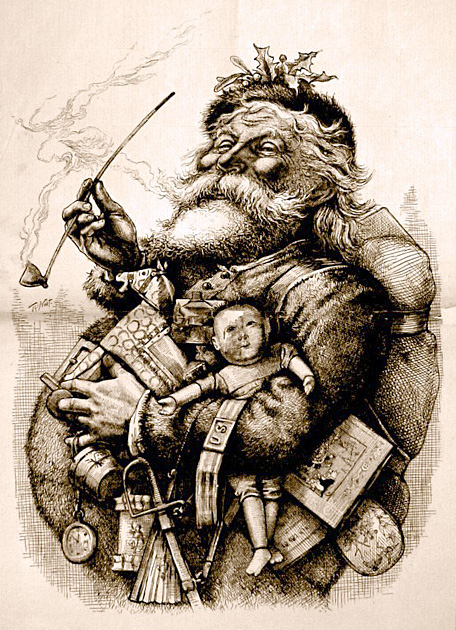
The real Santa Claus
We weren't sure how he arrived at this conclusion, since we'd never referred to Santa Claus as "bad" before, so we probed a little deeper. Maybe, we thought, someone at church had told him this? As time went on, we remembered that Dylan had just watched "How the Grinch Stole Christmas" a couple days earlier, and apparently, he still thought the Grinch was Santa Claus and that he was a bad guy!
As we thought more about it, we realized Dylan had never really heard or seen the classic story of Santa Claus as a jolly old elf who lives on the North Pole and delivers presents on Christmas Eve to boys and girls around the world. So, last week, we watched the 1960s animation "Rudolph the Red-Nosed Reindeer" as a family. (We've reminded Dylan several times that Santa is just a "fun story" while Jesus is real.)
Of course, neither the Grinch nor the elf in the red suit tell us the real story of Santa Claus...
Santa Claus's roots can be traced back to St. Nicholas of Bari. The son of wealthy parents, Nicholas was born in the fourth century in the town of Patara, Lycia (now part of Turkey). Legend records that when his parents died, the young man took all the family's money and distributed it to the needy in his hometown. He then accepted the call to full-time Christian service, becoming a monk when he was only seventeen, and shortly thereafter, a priest. ... Nicholas must have been a remarkable man, wise beyond his years and exhibiting a maturity that few gain until they are well past forty. (Ace Collins, Stories Behind the Great Traditions of ChristmasGene Edward Veith wrote an article in World Magazine a few years ago that reveals even more about this interesting character:, 159-60)
[Nicholas] was also a delegate to the Council of Nicea in a.d. 325, which battled the heretics who denied the deity of Christ. He was thus one of the authors of the Nicene Creed, which affirms that Jesus Christ is both true God and true man. And unlike his later manifestation, Nicholas was particularly zealous in standing up for Christ.Wow. I'm starting to like the real Santa Claus more and more.
During the Council of Nicea, jolly old St. Nicholas got so fed up with Arius, who taught that Jesus was just a man, that he walked up and slapped him! That unbishoplike behavior got him in trouble. The council almost stripped him of his office, but Nicholas said he was sorry, so he was forgiven.
New Blog
Today I'm closing up shop and launching a new blog called Pinch of Clay. You can visit it by clicking here . Please stop by and...
-
Heidi Amelia Jones was born at 3:11 this morning. She weighed in at 7 lbs., 4 oz., and is 20.25" long. Mama and baby are both doing wel...
-
You may have noticed a change in the Bible I preach from. That's because, after testing the Holman Christian Standard Bible for almost a...
-
I must admit, I still get confused by all those Herods mentioned in the New Testament. To keep them straight, I find it helpful to read the ...