Showing posts with label spiritual growth. Show all posts

Thursday, April 19, 2012

Am I Really a Christian?

As I mentioned in a previous post, we're using Wednesday evenings at First Southern to journey through a discipleship program called "Growing in Christ."

Our first series was "Am I Really a Christian?" based loosely on Mike McKinley's book that shares the same name. It focused on the need to examine ourselves spiritually and to look for evidence of being truly born again.

We recently concluded this first course, but it's not too late to follow along! All the handouts and even some of the audio recordings are available online. This would make a great self-guided study of basic Christianity.

Here's a complete list of the lessons:

"Am I Really a Christian?"
Growing In Christ, Course 1

Lesson 1:  Am I Really a Christian? (handout | request audio)
Lesson 2: More than a Name (handout | request audio)
Lesson 3: The New Birth (handout | request audio)
Lesson 4: Saving Faith (handout | request audio)
Lesson 5: Dead to Sin (handout | request audio)
Lesson 6: Finishing the Race (handout | request audio)
Lesson 7: Loving Others (handout | request audio)
Lesson 8: Contentment (handout | listen to audio)
Lesson 9: Assurance (handout | listen to audio)
Lesson 10: You're Not Alone (handout | listen to audio)

As you can see, some audio is available, though our podcast service has a limited data plan so I wasn't able to upload all of the lessons. The others are available by request. Just click on the link or leave a comment below and I can send you a copy of the other audio lessons.

Sunday, February 26, 2012

An inspiring story of love

Today we studied fifteen Marks of True Love from 1 Corinthians 13:4-7. Praise God that He has shown us unconditional love, and now calls us to love one another!

One of the most stunning examples of love I've seen took place at a softball game in the Pacific Northwest. Here's the full story...

Saturday, February 4, 2012

Pastor-teacher-administrator

Since I'm preaching on spiritual gifts right now, I figured it wouldn't hurt to take one of those spiritual gift tests. Here are the results:


Much to my relief, it says I'm gifted as a pastor. (Not sure what I would've done if I'd scored low in that area!) Not surprisingly, the areas of teaching and administration were also high.

Now, bear in mind, these tests are not fool-proof. And they're certainly not biblically required. The Holy Spirit was doing just fine for almost two-thousand years before these tests came along. If you take one, you'll notice that they are more a survey of what you enjoy doing and perceive about your own abilities. They can't factor in the essential role of others in the Body of Christ to affirm your gifts.

Nevertheless, the questions are interesting, and the results can be surprisingly accurate. If you've never done a spiritual gifts analysis, it may be one helpful way to "think with sober judgment" (Rom. 12:3) about your gifts. The one I did was through ChurchGrowth.org.


Which 2-3 gift(s) do you think you're strongest in? Did the survey confirm this, or reveal anything new? Any areas you need to grow in?

Tuesday, November 16, 2010

Two free audio books by John Piper

This month, you can get two audio books by John Piper for free. Thanks to christianaudio.com and Desiring God for these special deals. Here are the links:

Let the Nations be Glad: the Supremacy of God in Missions
(use coupon code GLAD10 at checkout; offer expires Dec. 31, 2010)

Summary: Why do we do missions? We are told, by Jesus, to preach the gospel and make disciples of all nations. So missions is duty, right? Wrong. If you do missions purely from a sense of duty you will not honor those you are reaching out to, nor will you truly honor God. Duty is the wrong place to look, so where do we find the answer to why we do missions? We turn, according to John Piper, to worship.

In our worship of God we encounter God's glory. The overflow from our worship is a desire to share God's glory with others (the chief end of man is to glorify God and enjoy Him forever), and we naturally become missional. When Jesus was asked what the kingdom of God was like, he compared it to a pearl so valuable that one would sell all they owned simply to possess it. Does that seem like duty to you? Instead, Jesus calls us to a new mindset, which flows from the mindset that worship creates in us. Thus, according to Piper, does worship become the goal of missions and the fuel which makes missions possible...


Don't Waste your Life

Summary: Millions of people are wasting their lives pursuing dreams of happiness that don't rise above a good marriage, nice kids, a successful career, a nice car, fun vacations, nice friends, a fun retirement, a painless death, and (hopefully) no hell. John Piper calls this a tragedy in the making. He argues that we were created for joy. We were designed to have one life-encompassing passion.

In this book he describes his own journey in discovering this great, single passion. And He pleads that at all costs we pursue our joy in the crucified Christ, who is the glory of God. The cost is great. But the joy is worth any cost. Don’t buy seductive, tragic promises of worldly joy. Don’t waste your life.

Wednesday, November 10, 2010

True treasure

Many dream of “striking it rich,” but few actually succeed. Mel Fisher began his quest for riches in 1969. He started to search off the Atlantic Coast for the Atocha, one of the few remaining Spanish galleon shipwrecks never recovered. It was thought to contain a fortune.

For sixteen long years, using state of the art equipment, Fisher scoured the ocean floor for any sign of the ship. Finally, on July 20, 1985, his son Kane announced, “Put away the charts; we’ve found the main pile!” Their find was dubbed the “shipwreck of the century,” worth hundreds of millions of dollars, and has been compared to the discovery of King Tut’s tomb.

Did you know you, too, could strike it rich? I’m not talking about the lottery. The Bible says “Happy is a man who finds wisdom…for she [wisdom] is more profitable than silver, and her revenue is better than gold. She is more precious than jewels; nothing you desire compares with her” (Proverbs 3:13-15). Find wisdom, and you’ve hit the real jackpot.

Wisdom is the ability to make good and godly choices in life. It’s more than just an IQ. Wisdom is an attraction to everything good, and true, and beautiful. It is not driven by emotions. It carefully weighs each option. It acts responsibly. It thinks about long-term consequences. It is street-wise in a dangerous and confusing world. Imagine how different things would be if we all spoke and acted with wisdom!

So, how do we find wisdom? Proverbs 9:10 provides the treasure map: “The fear of the LORD is the beginning of wisdom, and the knowledge of the Holy One is insight.” To gain wisdom we must first develop a healthy fear and respect for the living God.

This means we must recognize that God alone is pure and powerful, able to tell us how life works. We must admit our own sense of direction is faulty. We must believe God’s Word is more reliable than our closest friend, our smartest professor, or our favorite talk show host. We must accept that Jesus alone can rescue us from our sin, for “in Him are hidden all the treasures of wisdom and knowledge” (Colossians 2:3).

True wisdom begins with the fear of the Lord. And the fear of the Lord begins with knowing Christ. Only then can we become truly rich. Even richer than Mel Fisher.

This article was written for publication in today's edition of our local paper, the Hi Desert Star.

Monday, September 27, 2010

Our identity in Christ

“For me, to live is _____.” How would you fill in that blank? What excites you? What gets you up in the morning? What occupies most of your thoughts, your time, your talents, and your treasure? Recently, I was reminded that as a Christian, my identity is found first of all in Jesus Christ.

I love being a husband, a daddy, and a pastor. I really enjoy hobbies like hiking, geocaching, reading, and stargazing. But most importantly, I want it to be said , “You can’t truly know Stephen Jones unless you know his Savior.” I want to be so acquainted with Jesus, so interwoven with Him, that our lives and identity are inseparable.

The idea of “union with Christ” appears many times in the New Testament in a tiny two-word phrase we often skim right past. It’s the phrase “in Him.” If you have surrendered your life to Jesus and trusted in His substitutionary death for your sin, then your life is already hidden “in Christ.” Ephesians 1:7 says “In Him we have redemption through His blood, the forgiveness of our trespasses, according to the riches of His grace.” And 2 Corinthians 5:21 says the Father “made Him who knew no sin to be sin on our behalf, so that we might become the righteousness of God in Him.” If you’re a Christian, then your identity is now wrapped up in
Jesus. You’re a little branch attached to the life-giving Vine.

This is the most wonderful news in the world! It means you can have assurance, because you now belong to Christ. You are His, and He is yours. There’s nothing you can ever do to earn or forfeit your salvation, because you’re already fused and fastened together with your Savior through faith. But there’s another implication to this. It means your life must be separate from the world. Your thoughts and behavior (walk) must be radically different than before you were saved. “Therefore as you have received Christ Jesus the Lord, so walk in Him” (Colossians 2:6). “The one who abides in Him ought himself to walk in the same manner as He walked” (1 John 2:6).

So, how does the Apostle Paul fill in the blank, “For me, to live is _____”? You’ll have to look up Galatians 2:20 to find the answer. But I’ll bet you can guess it has something to do with his identity in Christ. May the same be true of us.

Friday, August 27, 2010

Great news for Bible study

Today is a great day for Bible study, with two exciting new resources.

1. The ESV MacArthur Study Bible. After much anticipation, the MacArthur Study Bible is now available for the ESV. Here's a description of this excellent Bible study tool:
An “essentially literal” translation, the ESV Bible combines “word-for-word” accuracy with readability, literary excellence, and depth of meaning. Timeless, trustworthy, and relevant, the ESV has become the fastest-growing Bible translation.

The ESV MacArthur Study Bible is an essential resource for growing Christians. It can transform your personal time in God’s Word by clarifying difficult passages, bringing unseen cultural and historical details to life, and helping you understand and apply biblical truth. It features:
  • Complete ESV Bible text
  • Nearly 25,000 explanatory notes from Dr. John MacArthur
  • Bible text in 8.7 point type, 7.6 point study notes
  • More than 140 two-color maps, charts, timelines, and illustrations
  • Complete introductions to each Bible book
  • Concise articles on How We Got the Bible and Introduction to the Bible
  • 80,000 cross-references
  • An extensive concordance
  • A section of full-color maps
  • Bible reading plans
2,144 pp. Hardcover.
Size: 6.625 x 9.1875 inches
Here's a short video of John MacArthur explaining the product. I watched this video at Shepherd's Conference in March, and particularly surprised to hear his glowing compliments of the ESV translation.


The ESV MacArthur Study Bible is now available through Amazon for only $29.69 and free Super Saver Shipping.

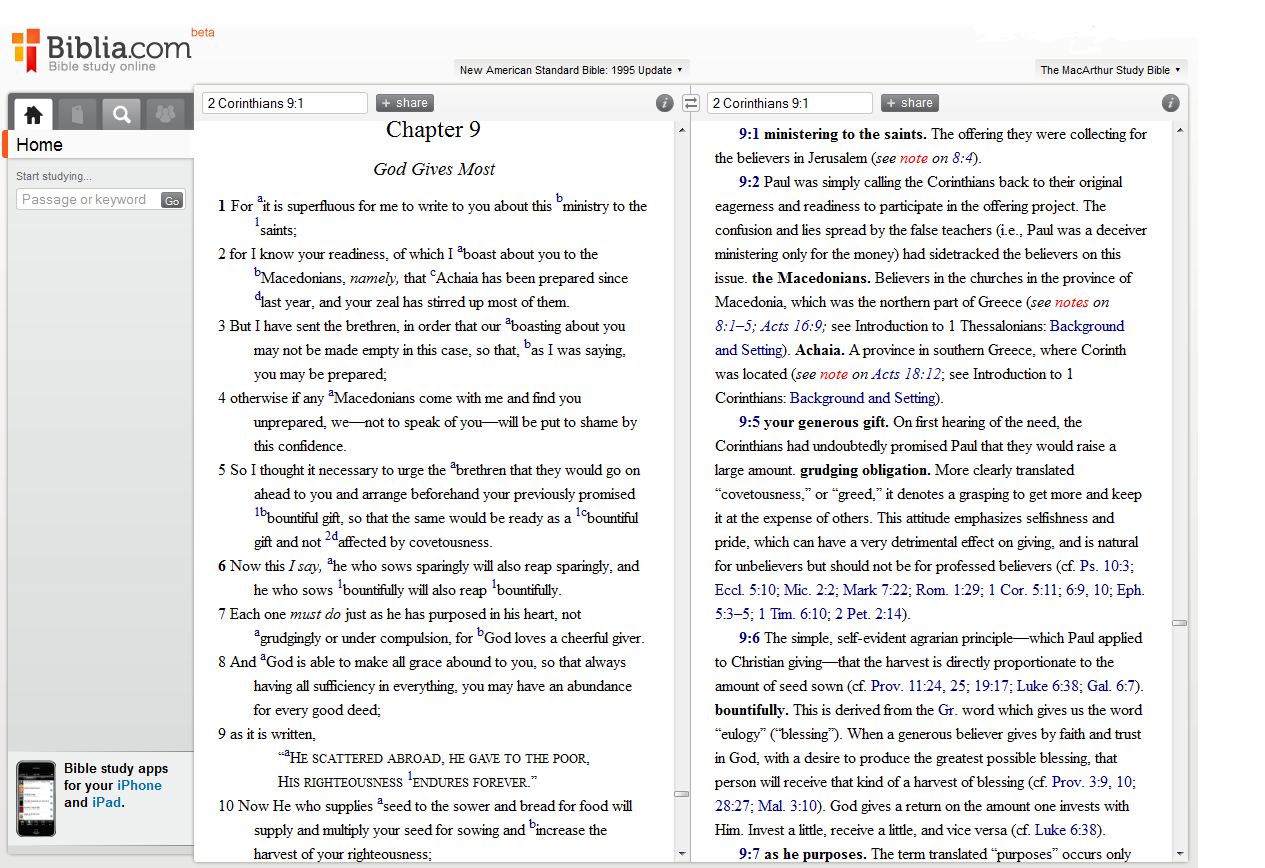
2. Biblia.com Bible study online. Today also marks the release of an amazing free Bible study tool online called biblia.com. Many of us have grown familiar with the great website biblegateway.com, but here we have a program even more robust, which links users directly to any books they own in Logos Bible Software.

Here's a screenshot:


The Logos Blog announcement explains,
Biblia.com offers thousands of resources for searching and reading online. Everyone can use a small collection of books (including more than a dozen bible translations). A free account allows access to dozens more free books. And Logos 4 users can access their library online, complete with synchronization of “last read” position between Logos 4, the iPhone/iPad, and Biblia.com! (The list of books available online is subject to publisher permission, as with availability through mobile applications.)

In the future, everyone will be able to purchase content at Biblia.com and use it wherever they choose: online, on mobile devices, in Logos Bible Software 4, etc.
Go over to biblia.com and see for yourself.

We are so blessed to live in an age with so many Bible study resources at our fingertips. May we use these tools not simply to grow in head knowledge, but to grow in holiness and intimacy with our Lord.

Thursday, July 29, 2010

15 questions for your marriage

Sometimes we need a little help communicating with our spouse effectively. How about setting aside a night and answering these 15 questions together? Here's the full post by Justin Taylor:

In the latest Journal of Biblical Manhood and Womanhood Rob Lister has a good article filled with practical suggestions for married couples to use in evaluating their marriage. The whole thing is worth reading for counsel on how and when to do this.
Below are the 15 questions:
  1. On a scale of 1-10, give your overall assessment of our marriage in the past six months. To be sure, this is a very broad and subjective item, but I have found it helpful to open the conversation with an item of this kind of breadth, because it helps to prime the pump. Obviously, you won’t hit on a ton of specifics with this one—that’s what the rest of the questions are for—but I have been truly amazed at just how much discussion this assessment alone can generate, as various issues come to mind. From there, we’re off and running. Follow-up questions in the event that the conversation fails to gain traction initially: What have been the strengths of the past six months? What would make your assessment higher?
  2. How has the husband’s leadership been over the past six months? The wife’s support? Follow-up: How can I improve in fulfilling my respective role?
  3. How is your walk with God, both personally and as a couple?
  4. Where do you see ungodliness in my life?
  5. Do I have any unconfessed sin that needs to be shared with my spouse?
  6. Are we guarding meaningful time together? Prayer? Conversation? Date Night?
  7. How is our sex life?
  8. What could I do to make you feel more loved/secure/respected?
  9. How can I serve you better?
  10. What are the issues that we need to anticipate in the upcoming six months?
  11. What’s your greatest personal disappointment and your greatest satisfaction in the last six months?
  12. How can I best pray for you?
  13. What are our major upcoming mutual prayer concerns?
  14. Spend a few moments, in an encouraging fashion, sharing several of the things that each of you loves and appreciates about the other.
  15. Then close, by spending some concerted time in prayer for those prayer concerns you just shared, as well as thanking God for his faithfulness to you as a couple over the past six months.
The article is also available as a PDF.

Friday, July 23, 2010

Blessed are the Broken and Gentle

Many thanks to Bret Capranica for filling the pulpit and feeding our flock the two weeks my family was on vacation.

I heard a lot of positive feedback from his sermons. His second week, Bret preached an entire message on one verse. One person remarked, "he went deep, but it didn't feel deep." I can think of no greater compliment. What a gift to plumb the depths of God's Word without becoming confusing and esoteric in the process.

Here are links to his two messages, both taken from the Sermon on the Mount. I am looking forward to listening to them myself!

Values of the Ultimately Satisfied: Brokenness 
(Matt. 5:1-3)

Values of the Ultimately Satisfied:Gentleness 
(Matt. 5:5)

Thursday, April 15, 2010

Saints in sin city

Last Sunday, our church began a new journey through the Book of 1 Corinthians. And in a way, the Apostle Paul picks up right where the Apostle John left off in his Gospel. The recurring theme of John was "Believe in Christ!" (John 20:31), and in 1 Corinthians, we see what the fruit of that belief should look like.

In fact, the struggle of the Corinthians could be summed up by Jesus' own prayer in John 17:15-18, "I do not ask You to take them out of the world, but to keep them from the evil one. They are not of the world, even as I am not of the world. Sanctify them in the truth; Your word is truth. As You sent Me into the world, I also have sent them into the world." Paul writes 1 Corinthians to a church struggling to be in the world, yet not of the world. To carry out Christ's mission in the world without becoming totally corrupted by it.
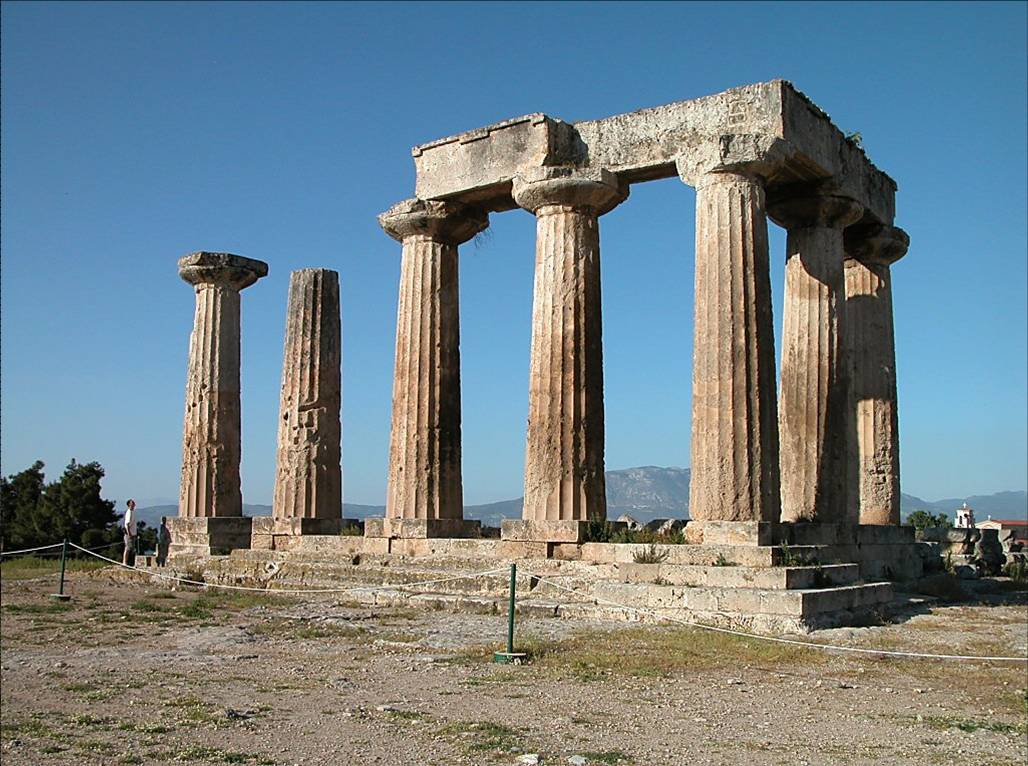
  1. The church of Corinth (1 Cor. 1:1-2). We began with some historical background on the city of Corinth. This was a wealthy city, located at a major crossroads of both land and sea. It was full of idolatry and immorality, to such a degree that to "Corinthianize" has become a byword for every kind of lewdness and debauchery. The Corinthians were saved from this lifestyle (1 Cor. 6:9-11), but as we will see in coming weeks, they were losing their battle against sin. In our increasingly post-Christian world, the culture is beginning to look more and more like Corinth. We must be wary that our church does not look more and more like the the Corinthian church. 
  2. A message of hope (1 Cor. 1:2-3). Found within Paul's greeting is an incredible message of hope. Despite their grievous sins, Paul does not write off this church, but views them as "sanctified in Christ Jesus, saints by calling." Just like the people of Israel were to be a holy nation, set apart from the pagan nations, so the church is called to be holy and set apart from the world. God is a holy God, and we are to reflect the holiness of the One who saved us. This is already our present position through the gospel (Heb. 10:10). But it is also what we are to become in our behavior (1 Pet. 1:15-16).
Questions for thought and discussion:
  • Have I trusted in Jesus Christ alone for eternal life? Can it truly be said that I am "sanctified in Christ Jesus?"
  • What does it mean to be "sanctified" and a "saint"? Do these words accurately describe my life? 
  • What corrupting influences fight against my holiness?
  • How could 1 Corinthians 1:2 bring hope to someone who feels so guilty that they are beyond Christ's reach?
  • Paul says that all who "call on the name of our Lord Jesus Christ" are saints by calling. What do you think this phrase means? Cf. Acts 2:21 and Romans 10:12.
  • Paul writes this letter to encourage and admonish his fellow Christians in Corinth. In a day when writing letters has fallen out of style, is there someone I need to take time to write or call and encourage in holiness?
Sunday's sermon is now available for free download on our podcast.


Photo credit: Todd Bolen

Thursday, February 18, 2010

Beware the Sirens

Breaking Free blog has an outstanding article today on the Siren Song of Greek mythology and what it teaches us about fighting pornography. It's one of the best things I've ever read on the subject.

Here's an excerpt.
I believe the Bible has both Odysseus- and Orpheus-mentalities, but more of the latter. In one sense Odysseus is commendable. He knows the danger of the siren song, so he makes diligent precautions to avoid making a deadly decision. We all need men like Odysseus’ shipmates, men who are willing to see through our mental fog caused by temptation, men who bind us fast and keep us from sinful choices, men who are willing to sit up with us at the midnight hour if we feel the draw of lust.  

But the Bible promises God will not only change our outward behavior, but He will change our desires. We are promised that though we are not now delivered from the presence of our fleshly desires, we can be delivered from their power.

I highly recommend reading the whole article here.

Monday, February 8, 2010

Gossip

An elderly man had hearing problems for a number of years. His family tried over and over to convince him to get hearing aids, so finally he relented. He went to the doctor and was fitted for a set of hearing aids that allowed him to hear perfectly once again. A month later he went back to the doctor. The doctor said with a smile, "Your hearing is great. Your family must be really glad you can hear again." The old man replied, "Oh, I haven't told my family yet. I just sit around and listen to their conversations. I've changed my will three times!"

I wonder if we would change how we talk about others if we knew they could hear our conversation. Whenever we speak of others in a way that is hurtful or unsubstantiated, we’re engaging in what the Bible calls gossip.

Now, I have to admit, there’s something exciting about gossip. We scan the tabloids with curiosity. We strain our ears to hear that discussion across the room. We gloat as we share a bit of new dirt we just learned. We lean into a conversation when some juicy detail is about to be revealed. As Proverbs 26:22 puts it, “The words of a whisperer are like dainty morsels, and they go down into the innermost parts of the body.”

But gossip isn’t harmless. It’s deadly. Proverbs 20:19 warns us, “He who goes about as a slanderer reveals secrets, therefore do not associate with a gossip.” Second Timothy 3:3 even says that a sign the end times are approaching is that many will be “unloving, irreconcilable, malicious gossips, without self-control, brutal, haters of good.”

Our words reveal a lot about what’s going on inside our hearts. Jesus taught in Matthew 12:34, “the mouth speaks out of that which fills the heart.” Does your speech imitate Christ, who has “done no violence, nor was there any deceit in His mouth” (Isaiah 53:9)? First God needs to wash our hearts. Then He needs to wash our mouths so we speak blessing instead of cursing.

Let’s resolve today, with God’s help, to say nothing about another person that we would be ashamed to say to their face. When we steer clear of gossip, we don’t have to worry about someone overhearing our conversation. We’ll just be glad they’re interested in what we have to say.

This article was written for the "Ministers Message" of our local newspaper, the Hi Desert Star, and appeared in last Wednesday's edition.

Monday, December 7, 2009

A technology revolution

Travin Wax has an interesting article today on technology and how it has changed our world. His examples show how the internet and social media have affected pop culture, politics, business, and religion.

His closing remarks:
We are living in the midst of a communications revolution. The only comparison that can be made is the invention of the printing press. Last time there was a communications revolution, a Reformation of the church took place. Will we see the new technology harnessed for the glory of God this time around?
I believe pastors and churches must strike a balance between embracing new technology while not putting our faith in it. We would be foolish to bury our heads in the sand and miss out on the opportunities technology provides, but we shouldn't become mesmerized by it.

Technology has connected our world in unimaginable ways, but on a spiritual level there's really nothing new under the sun. The deepest aspects of this world have remained constant: the nature of God, the depravity of man, the power of the Gospel, the role of the Spirit in conversion, the value of preaching, the need for prayer, the glory of the church, and the ruthless opposition of our Enemy. Our technology revolution has not changed these things in the slightest.

Related post:

Tuesday, November 24, 2009

Satisfied in Christ


What's the purpose of life? And what's the purpose of the church? The answer to both these questions is the same: to glorify God.

We exist to bring God glory, pleasure, and honor, and to reflect His beauty to others. But how do we bring God the greatest glory? The answer may be surprising to you. We bring God the greatest glory by enjoying Him. By really loving Him more than anything else. John Piper says it this way: "God is most glorified in us when we are most satisfied in Him."

Last Sunday, our church studied Psalm 63. It's the heartfelt song of King David, a man after God's own heart, who found his joy and satisfaction in God. We saw three reasons we too can be satisfied in God (who, this side of the cross, finds His fullest expression in Jesus Christ):
  1. Christ Satisfies our Thirst (Ps. 63:1-5). David, writing in a barren Judean wasteland (see picture above), speaks of a deep thirst and craving for God. He longs for God even more than his body cries for water. And his soul is deeply satisfied in God alone (v. 5). Jesus says something very similar to the Samaritan woman in John 3:13-14. Those who believe and drink deeply of Jesus will never thirst again, but will have a well of water springing up to eternal life.
  2. Christ Saves our Life (Ps. 63:6-8). David thinks back on the night before. As he lay on his bed, his mind had been occupied with the goodness of God. God had been David's help (v. 7) in many ways, and David had learned to cling to Him alone (v. 8).
  3. Christ Settles our Account (Ps. 63:9-11). Though his enemies were seeking his utter ruin, David had learned to find refuge in God. He knew that the Lord would one day intervene. What a comfort to know God will one day bring justice upon all His enemies. Vengeance is God's; He will repay. Our responsibility is to treat our enemies with love (Romans 12:14-21).
Based on Psalm 63, here are several discussion starters you could use around the Thanksgiving table or while traveling with family this week:
  • v. 2 - How did you "see God in the sanctuary" this year? What was one of your highlights at church in 2009?
  • v. 3 - God's lovingkindess is described as "better than life" (health, longevity, success). Can you think of someone who has exemplified this attitude in the last year? What can you learn from them?
  • v. 7 - How has God been your help in the last couple months? (Be specific)
  • v. 8 - Is there a time this year when you could really sense God holding you up?
  • v. 9 - Has anyone mistreated you this year? How did it make you feel? (Don't spend too much time dwelling on this, because love covers many sins and does not take account of wrong suffered. 1 Peter 4:8; 1 Cor. 13:5). Have you given this over to God, or are you still seething with anger? How does God want you to treat this person? (Rom. 12:14-21)
Sunday's sermon will be uploaded next week to our podcast site for free download.

Thursday, November 12, 2009

Final Call

Last Sunday, we finished our two-and-a-half year journey through the Gospel of John. It was a bittersweet moment.

Through John's Gospel, I've grown more passionate for my Savior, Jesus Christ. I've grown more confident of His deity. I've grown more amazed at His love for the Father and for me. I've grown more familiar with His ministry and teaching style. I've grown more appreciative of His gift -- the Holy Spirit. I've grown more amazed at His death on the cross. I've grown more convinced of His unique authority and powerful resurrection.

I've grown so attached to this Gospel, but I'm also excited to move on to a new book in the months ahead. I don't know for sure where we're headed yet, but I'm praying about starting 1 Corinthians around the beginning of the new year. I see an urgent need for holiness in the church, and know this letter touches on many of the issues facing Christians today.

As we wrapped up our series in John, we heard Christ give a final call to His disciples, a call which involved two commands:
  1. Follow your Savior at any cost (Jn. 21:18-19). The freedom Peter enjoyed earlier in life would one day be replaced by persecution and death. God had appointed for Peter to glorify Him through martyrdom -- probably "stretching out his hands" in crucifixion.
  2. Fix your eyes on Him alone (Jn. 21:20-25). After hearing this prophecy, Peter became curious of John's fate. Would he too tend Christ's sheep? Would he too be martyred? Jesus' response was a good rebuke to all of us, "What is that to you? You follow Me!"
Questions for thought and discussion:
  • How do I view death? What comfort can I find in John 21:19?
  • What does it mean to "deny ourselves and take up our cross" to follow Jesus? (Mark 8:34)
  • What have I given up to follow Jesus?
  • What do I still need to change in order for Jesus to completely take charge of my life?
  • Do I need to talk to a Christian friend to get help?
  • What is the only right motivation to a life of cross-bearing and self-sacrifice? See John 21:15.
  • On a scale of 1 to 10, how great is my affection for Christ?
  • How can I kindle that fire to love Him more?
  • Why do you think we're so prone to comparing ourselves to others like Peter did?
  • Who do I typically compare myself to?
  • What thoughts and feelings do I have when I compare myself to others?
  • Am I trying to run other people's lives? Who? Am I responsible for the decisions they make? Why or why not?
  • Am I resentful of God's blessing toward others? What should my response be?
Sunday's sermon has been uploaded to our podcast site and is available for free download.

Saturday, November 7, 2009

Overcoming addiction

I'm hoping in the next year to start a Bible-centered addiction recovery group at our church. And this may be just the resource: Crossroads: A Step-By-Step Guide Away from Addiction: Study Guide by Ed Welch.

Here's a description from the publisher.
Everyone of us is a potential addict. Eventually, every addict finds himself at a crossroads. In a pressure-filled world, the prospect of instant escape can be exhilarating. No matter the object-drugs, alcohol, food, gambling, or sex, just to name a few-addictions lure us. They extend the promise of pleasure. In the end, they deliver emptiness, death, and destruction. What began as an escape from the hassles of life becomes a form of bondage. Addiction is a voluntary slavery. Change doesn't come easily. But change is possible!

No matter how many times you have tried and failed, there really is a way through the addictive fog. There is a guidebook for living, and, contrary to what many think, it is available to anyone, even to those enslaved by an addiction. God is not silent on this issue. His Word offers hope, and that hope is the basis of Crossroads: A Step-by-Step Guide Away from Addiction.

Crossroads was designed as a group study for those struggling with addiction. These ten steps, presented in author Ed Welch's trademark direct, no-nonsense style, provide a biblical and practical framework for change. Welch is a wise and loving partner who walks beside readers on their journey to freedom. Along the way, they will learn to recognize the patterns of addiction, to choose wisdom over foolish desires, and to cling to the hope they have in Jesus, who sets captives free. The path away from addiction has been laid by a God who is full of surprises, who faithfully pursues those enslaved even though they have deliberately avoided him.

They've also created this short video.


Related post:

HT: Justin Taylor

Monday, November 2, 2009

Book review - Holiness

One of the great aims of the believer is to become “holy as God is holy” (1 Peter 1:16). So while we proclaim a “gospel of grace” (Ac. 20:24) and celebrate freedom in Christ (Gal. 5:1), we realize we were saved for a glorious purpose. We were not rescued from hell simply to bask in sin and lawlessness. We were, as Paul says, “created in Christ Jesus for good works” (Eph. 2:10).

Yet how do we take tangible steps toward this goal? Holiness can feel so abstract, so unattainable, that I fear many Christians never really take pains to achieve it. Over a century ago, the Lord gave us tremendous help through J.C. Ryle’s classic work Holiness: Its Nature, Hindrances, Difficulties, and Roots.

Interestingly, Ryle begins his book on holiness by discussing sin. “He must dig down very low if he would build high…Wrong views about holiness are generally traceable to wrong views about human corruption” (p. 1). From there, Ryle devotes his early chapters to the nature of sanctification and holiness, the fight for holiness, its cost, and the need for growth.

The middle chapters of the book focus on several fascinating character studies. Moses, Lot, Lot’s wife, and the thief on the cross serve as examples and warnings toward holiness.

The latter chapters (12-20) deal with a variety of topics. Ryle discusses Christ’s power, His promise to build the church, and His restoration of Peter, among other things. These chapters are solid expositions, though more loosely tied to the main thesis of the book. Ryle closes with a fitting reminder that Christ is all. “Christ is the mainspring both of doctrinal and practical Christianity…He that follows after holiness will make no progress unless he gives to Christ His rightful place” (p. 300).

I found this book a tremendous blessing. Though written in the late 19th century, Ryle communicates in a style that is both eloquent and earthy; both poetic and practical. Every page was full of encouraging and convicting truth. As I read it slowly, marked its pages, and saturated myself in it, I found it affecting my thoughts and prayer life and giving me a greater hunger and thirst for righteousness.

For Christians just beginning to learn about holiness, I would recommend first reading Jerry Bridges’ book The Pursuit of Holiness. It is much shorter and more contemporary. But Ryle definitely belongs on the Christian bookshelf and is worthy of multiple readings. What a difference it would make if every Christian in our church fed on such edifying material.

Tuesday, October 27, 2009

Breaking free from sexual sin

Tim Challies is writing this week on pornography and sexual sin. Excellent counsel so far. Here's an excerpt...
Every Christian guy who looks at porn wants to stop, but many of them want to stop just a little bit less than they want to keep going. And so sin prevails. The only way you will stop is if you begin to see the monstrous nature of the sin you are committing.
And then, this advice which I totally affirm:
If you truly want to overcome pornography, go to your pastor. There is not a pastor in America who is not helping someone deal with the fight against pornography (says I with only a small measure of hyperbole). Take your willingness to talk to somebody about your problem as a sign that you are actually, finally, willing to deal with it. The local church is the ideal context for battling this kind of sin since in the local church you will find the authority and the support to help you fight and, ultimately, to help you win. If you want to overcome pornography, truly overcome it, you will be willing to humble yourself and talk to someone about it.
You can read the whole thing here.

Related post:

Tuesday, October 13, 2009

Jump, I'll catch you

Here's a beautiful picture of faith, from a sermon by John Piper...
Your daddy is standing in a swimming pool out a little bit from the edge. You are, let’s say, three years old and standing on the edge of the pool. Daddy holds out his arms to you and says, “Jump, I’ll catch you. I promise.” Now, how do you make your daddy look good at that moment? Answer: trust him and jump. Have faith in him and jump. That makes him look strong and wise and loving. But if you won’t jump, if you shake your head and run away from the edge, you make your daddy look bad. It looks like you are saying, “he can’t catch me” or “he won’t catch me” or “it’s not a good idea to do what he tells me to do.” And all three of those make your dad look bad.

But you don’t want to make God look bad. So you trust him. Then you make him look good–which he really is. And that is what we mean when we say, “Faith glorifies God” or “Faith gives God glory.” It makes him look as good as he really is. So trusting God is really important.

And the harder it seems for him to fulfill his promise, the better he looks when you trust him. Suppose that you are at the deep end of a pool by the diving board. You are four years old and can’t swim, and your daddy is at the other end of the pool. Suddenly a big, mean dog crawls under the fence and shows his teeth and growls at you and starts coming toward you to bite you. You crawl up on the diving board and walk toward the end to get away from him. The dog puts his front paws up on the diving board. Just then, your daddy sees what’s happening and calls out, “Johnny, jump in the water. I’ll get you.”

Now, you have never jumped from one meter high and you can’t swim and your daddy is not underneath you and this water is way over your head. How do you make your daddy look good in that moment? You jump. And almost as soon as you hit the water, you feel his hands under your arms and he treads water holding you safely while someone chases the dog away. Then he takes you to the side of the pool.

We give glory to God when we trust him to do what he has promised to do–especially when all human possibilities are exhausted. Faith glorifies God. That is why God planned for faith to be the way we are justified.
HT: Justin Taylor

Wednesday, October 7, 2009

Is it really OK to look?

So, I clicked on ESPN.com this morning to check the sports headlines when suddenly **BAM** I was hit with a photo of a male and two female athletes, apparently in the buff with legs and arms cleverly positioned. The photo caption:

"It's OK to look: A lifetime of athletic ambition makes some bodies better than others. See for yourselves."

Apparently, this is a preview for the "Body Issue" of ESPN Magazine (presumably their alternative to the annual "Swimsuit Issue" in Sports Illustrated).

So is it really OK to look and admire these sleek, ripped, and oiled bodies? It's no accident that two athletes in the cover photo were female, despite the fact that most sporting events on TV feature male athletes. My flesh wanted to look, but my spirit (conscience) was screaming out, "Whoa, hold on there just a minute. This isn't cool. It's a lie. Don't even think about clicking on that link!"

I am reminded of the sermon I preached on sexual purity at last Saturday's Exposing the Heart men's conference. The world is sending a message loud and clear: "Come. Look. Enjoy. Drink your fill. Don't let anyone else stop you from being happy." Today's headline at ESPN only confirms this. But God sends a very different message of purity - for His glory and for our joy.

In Matthew 5:27-30, Jesus gives three dimensions to sexual purity:

1. The External (Matt. 5:27). Quoting from the Ten Commandments, Jesus reminds us of God's command "You shall not commit adultery." Sex is not bad in itself. After all, God invented it. Satan can only twist and distort it. But God created clear sexual boundaries for our protection and joy. As Hebrews 13:4 says, "Marriage is to be held in honor among all, and the marriage bed is to be undefiled; for fornicators and adulterers God will judge." Adultery is not merely an "affair" to be shrugged off and laughed at like David Letterman. It is a serious breaching of the marriage covenant, an offense that will be reckoned by the Holy Judge Himself.
2. The Internal (Matt. 5:28). As awful as adultery is, Jesus says there is a sin perhaps even more dangerous, because it is far more subtle. It is a sin we face every day: lust. Christian counselor Stuart Scott defines lust as "nothing more than evil desire looking for fulfillment. It is only looking for self-satisfaction … Lust is welcoming and continuing in the evil desires of the flesh, rather than resisting them and fleeing from them by turning to God and what is right.” ESPN says, "It's OK to look at these photos." Jesus says, "Looking is adultery of the heart." As difficult as it may be, we must fight every day not to look with lust. We must develop pure relationships (1 Tim. 5:2) and avoid every form of evil (1 Thess. 5:22). God's will for us is sanctification (1 Thess. 4:3).
3. The Eternal (Matt. 5:29-30). Jesus puts lust in perspective for us with a call to radical action. Searing your conscience and giving in to sin is a dangerous sign that you may not be saved. Sin may be pleasant for a while, but it only leads to death and eternal torment in hell. It doesn't deliver what it promises. Far better to give up your pet sin and change your lifestyle (alter your commute, cancel that subscription, cut off that relationship, miss that TV show, or whatever it takes) rather than stumble into sin and jeopardize your soul. Stop making excuses. Know your sin, and fight it to the death. Cast yourself on God's grace, and take extreme measures.

As Solomon said, "I have discovered more bitter than death the woman whose heart is snares and nets, whose hands are chains. One who is pleasing to God will escape from her, but the sinner will be captured by her" (Eccl. 7:26). In this life under the sun, opportunities for lust abound, but Solomon reminds us they are all mere traps, set to kill.

Thankfully, we have a pure and sinless Redeemer, Jesus Christ. Never once did Jesus have a lustful thought. He was tempted to lust (Heb. 4:15), but He never, ever gave in. Because Christ was sinless, He was qualified to become the spotless Lamb of God and take away the sin of the world. God punished Him for our lust, and gave us Christ's righteousness in its place. (2 Cor. 5:21) What an exchange!

So before you decide it's "OK to look" at the ESPN Body Issue or any other occasion for lust, remember the trap. Remember the marriage covenant. Remember that eternity is at stake. Remember what Christ did for you.

As our love for God grows, may we begin to see sin for what it really is, and stop finding it so attractive. May we instead see that God's glory and His moral boundaries alone can offer true joy.

New Blog

Today I'm closing up shop and launching a new blog called Pinch of Clay. You can visit it by clicking here . Please stop by and...