As I write this article, my wife and I are getting ready to take our seven-month old daughter Abigail down to Loma Linda for surgery on her right kidney. We’re thankful that little Abby will get excellent care and has a high probability of success. But even more importantly, we’re thankful she is in God’s loving hands.
Life is not easy. We often have to live by faith, and not by sight. One of the ancient prophets who learned this was Habakkuk. His name in Hebrew means “the clinger,” and that is precisely what God taught Him -- to cling to the Lord every day.
Habakkuk lived in turbulent times. There was famine in Israel, and the army of Babylon was approaching. Hungry and outnumbered, the Israelites trembled. After all, Babylon did not have a reputation for showing mercy to their prisoners of war.
But as the chariots thundered closer and the infantry kicked dust high into the air, Habakkuk gathered his composure and wrote a beautiful poem of trust in God:
“Though the fig tree should not blossom, nor fruit be on the vines; the produce of the olive fail and the fields yield no food; the flock be cut off from the fold and there be no herd in the stalls, yet I will rejoice in the Lord; I will take joy in the God of my salvation. God, the Lord, is my strength” (Habakkuk 3:17-19).
The prophet’s forecast looked bleak. Tasty treats like figs and grapes would soon dry up. Then staple crops like olives and wheat would fail. Finally, all the animals would die from starvation or enemy slaughter. But in spite of this, Habakkuk put his joy in the Lord and kept clinging to him.
Can the same be said of us? Thankfully, we aren’t defending against an enemy attack or in a life-threatening drought. But many of us are in an uphill battle every day. Financial trouble. Sickness. Loneliness. Addiction.
Don’t despair! God is still our strength. He will care for us, if we will turn to him. He already proved his love by giving his son to die for our sins. And in the end, he will make all things new for those who trust in Jesus (Revelation 21:5).
By the time you read this, Abigail’s surgery should be over. Hopefully, she will already be on the road to recovery. But no matter what, we know we can cling to God and rejoice in Him, for He is our strength.
This article was written last week for publication in today's edition of our local newspaper, the Hi Desert Star.
Showing posts with label suffering. Show all posts
Showing posts with label suffering. Show all posts
Wednesday, September 28, 2011

Saturday, September 24, 2011
Abby's surgery

The surgeon will make a small incision on her side, remove a piece of her ureter where it joins to the kidney, then reconnect the ureter to the kidney. The operation will take place at Loma Linda Children’s Hospital and should take 2-3 hours. If all goes well, most of her kidney will be saved, and she could be discharged as early as Tuesday afternoon.
Here are some ways you can pray for our family:
- Thank the Lord that doctors noticed her condition early, that she is not in any pain, and that her right kidney still has a lot of healthy tissue
- Pray that she will stay healthy, as she has been fighting off a cold and allergies this past week
- Ask God to guide the hands of Dr. Chamberlain, his staff, and medical students as they operate on our daughter
- Pray for God to sustain Natalie and me, as we are already tired from so many other medical crises in the past year
- Intercede for us, that we will not give into fear, but will rest in God’s sovereignty, his wisdom, and his love. We want to know our Savior better through this season of suffering
- Praise the Lord for Natalie’s parents who are watching Dylan and Heidi for the week so we can focus on caring for Abby. My mom will also be arriving in another week to help out.
- I’ve written about this trial in a “Minister’s Message" scheduled to be published next Wednesday in our local newspaper. Pray that God will use this article to draw other people to himself.
- Pray for Abby’s salvation. As she grows older, we hope God will give her a heart that loves and serves Jesus.
I will rejoice in the LORD;
I will take joy in the God of my salvation.
GOD, the Lord, is my strength
(Habakkuk 3:18-19)
Thursday, August 11, 2011
Update on Natalie
Please continue to pray for Natalie as she recovers from yesterday’s gallbladder surgery. Her blood pressure has remained pretty stable, but her hemoglobin has gone down a tad, and she’s in an inordinate amount of pain.
The doctor has ordered another sonogram to see what’s going on. They’ve also withdrawn food and liquids just in case she needs another surgery. I wonder if there might be some internal bleeding going on?
I stayed at home with the kids overnight, but will head back out to the hospital this morning as soon as Liz Tyree gets here to babysit the kids. Thank you for all your prayers. We serve a great and mighty God. He is a Loving Father, and He hears our prayers.
Here’s a quote I read from Paul Enns’ book Heaven Revealed yesterday. What comfort for the soul:
Hoping in Christ,
Stephen
The doctor has ordered another sonogram to see what’s going on. They’ve also withdrawn food and liquids just in case she needs another surgery. I wonder if there might be some internal bleeding going on?
I stayed at home with the kids overnight, but will head back out to the hospital this morning as soon as Liz Tyree gets here to babysit the kids. Thank you for all your prayers. We serve a great and mighty God. He is a Loving Father, and He hears our prayers.
Here’s a quote I read from Paul Enns’ book Heaven Revealed yesterday. What comfort for the soul:
“On this sinful, fallen earth, life will remain difficult, fraught with suffering and sadness. But we are looking forward to heaven – and heaven is always better in every realm than the earth. We should never question, doubt, or worry whether we will ‘enjoy’ heaven. We will enjoy heaven to the utmost; every moment in heaven will be better than the best moments we ever have on this fallen earth. The suffering on this earth will be a thing of the past – forever … Isaiah says believers will ‘come with joyful shouting to Zion, and everlasting joy will be on their heads. They will obtain gladness and joy, and sorrow and sighing will flee away’ (Isa. 51:11).”
Hoping in Christ,
Stephen
Saturday, July 9, 2011
Be still my soul
Heard a peaceful instrumental version of this song playing on the radio last night. It was a good reminder as Abigail undergoes testing at the hospital for a possible heart condition...
Be still, my soul—the Lord is on thy side!
Bear patiently the cross of grief or pain;
leave to thy God to order and provide—
In ev’ry change He faithful will remain.
Be still, my soul—thy best, thy heav’nly Friend
thru thorny ways leads to a joyful end.
Be still, my soul—thy God doth undertake
to guide the future as He has the past;
thy hope, thy confidence let nothing shake—
All now mysterious shall be bright at last.
Be still, my soul—the waves and winds still know
His voice who ruled them while He dwelt below.
Be still, my soul: when dearest friends depart,
And all is darkened in the vale of tears,
Then shalt thou better know his love, his heart,
Who comes to soothe thy sorrow and thy fears.
Be still, my soul: thy Jesus can repay
From his own fullness all he takes away.
Be still, my soul: the hour is hast'ning on
When we shall be for ever with the Lord,
When disappointment, grief, and fear are gone,
Sorrow forgot, love's purest joys restored.
Be still, my soul: when change and tears are past,
All safe and blessed we shall meet at last.
Wednesday, September 1, 2010
Prosperity theology vs. poverty theology
Yesterday I watched a 15-minute interview between Mark Driscoll, Joshua Harris, and Francis Chan. Francis is preparing to leave a thriving ministry at Cornerstone Church in Simi Valley to start a church plant in inner city L.A. In the meantime, he plans to spend some time in a third world country to gain a fresh perspective and see things apart from the hustle and bustle of American life. His goal in this whole endeavor seems to be to follow Jesus, to get back to early church life, and to strip away the misconceptions of how ministry should be done.
In the interview, Driscoll asks Chan some very penetrating questions: How do you know that in several years, you're not going to grow dissatisfied with this new endeavor as well? Is there a danger that we have exchanged the error of a prosperity theology with the error of a poverty theology? In other words, since we know God often sanctifies us through poverty, simplicity, and suffering, have we decided that riches, complexity, and health are intrinscially bad? Should we feel guilty or ashamed by these things and deliberately avoid them?
This conversation hits the nail on the head, and echos cautions made by Mark Dever to David Platt at the IX Marks at 9 seminar in Orlando last June. See also Kevin DeYoung's review of Radical, where he says,
Most of us are still far from the danger of a poverty theology, and still have much to benefit from the almost prophetic lifestyle and ministry of Platt and Chan. But I appreciate Driscoll's warning against a Catholic form of asceticism that may be subtly at work here which could ultimately undermine the gospel itself.
In the interview, Driscoll asks Chan some very penetrating questions: How do you know that in several years, you're not going to grow dissatisfied with this new endeavor as well? Is there a danger that we have exchanged the error of a prosperity theology with the error of a poverty theology? In other words, since we know God often sanctifies us through poverty, simplicity, and suffering, have we decided that riches, complexity, and health are intrinscially bad? Should we feel guilty or ashamed by these things and deliberately avoid them?
This conversation hits the nail on the head, and echos cautions made by Mark Dever to David Platt at the IX Marks at 9 seminar in Orlando last June. See also Kevin DeYoung's review of Radical, where he says,
We must do more to plant the plea for sacrificial living more solidly in the soil of gospel grace. Several times David [Platt] talks about the love of Christ as our motivation for radical discipleship or the power of God and the means for radical discipleship. But I didn’t sense the strong call to obedience was slowly marinated in God’s lavish mercy. I wanted to see sanctification more clearly flowing out of justification.
Most of us are still far from the danger of a poverty theology, and still have much to benefit from the almost prophetic lifestyle and ministry of Platt and Chan. But I appreciate Driscoll's warning against a Catholic form of asceticism that may be subtly at work here which could ultimately undermine the gospel itself.
Wednesday, March 31, 2010
Hospital visits
Some pastors loathe the hospital. I have come to find it one of the most precious places on earth to shepherd God's people. No one is there by choice. Yet those who end up there need the tender touch and compassionate words of a shepherd. This is one of those golden opportunities to live out 1 Thessalonians 2:7-8:
"But we proved to be gentle among you, as a nursing mother tenderly cares for her own children. Having so fond an affection for you, we were well-pleased to impart to you not only the gospel of God but also our own lives, because you had become very dear to us."
Hospital visits are deeply humbling moments when we love and treat our flock with dignity, supply the medicine of God's Word, and try to keep our wits and a good sense of humor. Just last week, as I visited a church member in a continuing care facility, the patient next to her kept interjecting into our conversation. She seemed a bit eccentric and kept asking me how to operate her cell phone. Finally, I checked her minutes and discovered she had used them all up. But as I ended the visit, I was able to include the roommate in our prayer time.
I often try to put the patient at ease by talking about the weather, about life, about my family, and about recent church events. I ask how their family is doing, about some of their fond memories, and pleasant conversation points with the outside world. What I avoid is excessive talk about their health or discussing current political events (they're probably hearing about those things all day on their TV anyway).
Toward the end of the visit, before I pray, I often like to ask if I can read a passage of Scripture as an encouragement to them. Brian Croft in his blog today gives four categories and samples of Scriptures which are very helpful:
Related posts:
"But we proved to be gentle among you, as a nursing mother tenderly cares for her own children. Having so fond an affection for you, we were well-pleased to impart to you not only the gospel of God but also our own lives, because you had become very dear to us."
Hospital visits are deeply humbling moments when we love and treat our flock with dignity, supply the medicine of God's Word, and try to keep our wits and a good sense of humor. Just last week, as I visited a church member in a continuing care facility, the patient next to her kept interjecting into our conversation. She seemed a bit eccentric and kept asking me how to operate her cell phone. Finally, I checked her minutes and discovered she had used them all up. But as I ended the visit, I was able to include the roommate in our prayer time.
I often try to put the patient at ease by talking about the weather, about life, about my family, and about recent church events. I ask how their family is doing, about some of their fond memories, and pleasant conversation points with the outside world. What I avoid is excessive talk about their health or discussing current political events (they're probably hearing about those things all day on their TV anyway).
Toward the end of the visit, before I pray, I often like to ask if I can read a passage of Scripture as an encouragement to them. Brian Croft in his blog today gives four categories and samples of Scriptures which are very helpful:
- Passages of comfort (Ps. 23, 28, 34, 46, 62, 145; Heb. 4:14–16)
- Succinct gospel passages (John 11:25–26, Rom. 5:6–11, Eph. 2:1–10, 2 Cor. 5:17–21)
- Passages dealing with the purpose of suffering for the believer (2 Cor. 12:7–9, James 1:2–4, 1 Pet. 1:6–7, 1 Pet. 4:12–19)
- Passages related to the reality and hope of eternity with Christ (John 10:27–30, John 14:1–3, Phil. 1:21–23, 1 Pet. 1:3–5)
Related posts:
Friday, March 26, 2010
Faith in the Famine

Two weeks ago, we were introduced to Haggai and Zechariah, a "tag team" commissioned by God around 520 BC to spur on Israel and its leaders to rebuild the temple after the Babylonian exile. We were reminded that joyful obedience to the commands of God comes "not by might, nor by power, but by My Spirit" (Zech. 4:6).
Then, last Sunday, we turned over to the prophet Habakkuk, who ministered almost a century earlier, before the temple had been destroyed. When Habakkuk grieved over the sin of Israel (Hab. 1:1-4), God told him He was going to use Babylon to discipline His people (Hab. 1:5-11). This came as a total shock to Habakkuk, who couldn't imagine how a holy God could possibly allow an even more wicked people to "swallow up" God's chosen people (Hab. 1:12-2:3)! God then reassured Habakkuk that the righteous would endure by faith (Hab. 2:4), and that Babylon too would be severely humbled -- as soon as they completed God's assignment (Hab. 2:5-20). Habakkuk closes the short book with a song describing God's glorious appearance (Hab. 3:1-15) and a commitment to trust in God no matter what (Hab. 3:16-19).
Last Sunday, we focused on the final four verses of the book. We noticed three points:
- The prophet's fear (Hab. 3:16). Habakkuk staggered as he saw the vision of God (vv. 1-15) and considered the full weight of the judgment that was about to land upon Judah. But he resolved to wait quietly for whatever trials the Lord had prepared.
- The nation's famine (Hab. 3:17). God was about to devastate Israel not only with an invading army, but with a severe famine. Things would gradually worsen as figs, grapes, olives, grain, flocks, and cattle all died. Habakkuk paints a bleak picture, but doesn't stop to worry. He immediately takes these concerns and says, in spite of it all, "I will trust in God!"
- The prophet's faith (Hab. 3:18-19). Here we have a dramatic shift in tone, to one of triumph, victory, safety, and joy. God becomes the focus, rather than Habakkuk's circumstances. Just like a deer or a bighorn sheep, we are kept safe in dangerous places. We can "rejoice in the God of our salvation" even in life's darkest moments.
- The name "Habakkuk" means "one who embraces." Why is that significant in this book?
- Have you ever "trembled" inwardly like Habakkuk (3:16)? When?
- What are your greatest fears in life?
- What are your greatest physical, financial, and spiritual difficulties?
- Try re-writing verses 17-18 in your own words, inserting trials that you have or could face
Photo credit: brtsergio
Thursday, February 25, 2010
The Stony Soil

The Parable of the Seed (Mk. 4:26-29) reminded me that gospel ministry is entirely a work of God. It is a mysterious delight to watch God take my feeble efforts and produce something holy and supernatural.
The Parable of the Soils (Mk. 4:1-20) reminded me that there may be some in our very church who think they are saved when in reality they are not. This is one of the longest parables delivered by Jesus, and it is unique because it is more of a true "allegory," i.e. multiple elements of the story have a spiritual meaning. The seed represents the Word of God; the soils represent different hearts; the birds represent Satan. And as we discovered last Sunday in our second week of exposition in this passage, the sun represents the scorching heat of affliction. Together we discovered three lessons from the stony soil:
- Be careful of your emotions. Jesus says that stony-soiled people "immediately receive [the Word] with joy" (Mk. 4:16). They start so well but end tragically. They're truly excited about Jesus, but when suffering comes their way, they begin to feel "buyers remorse." In our emotion-driven culture, we must realize emotions can be very deceptive. They are not inherently evil, but they do tend to be tossed to and fro based on our current circumstances. They're certainly not a sturdy foundation for our faith! How do we overcome a fickle, emotion-driven faith? That brings us to our second point...
- Root yourself deeply in Christ. Notice that the reason the plant withers is because "it had no depth of soil...it had no root" (Mk. 4:5, 6). A plant cannot escape the sun. A plant cannot adjust the temperature of the sun. The only thing a plant can do is root itself deeply in the moist, nutrient-rich soil to endure the scorching heat of the sun. In the same way, if we are to endure intense suffering in life, we must root ourselves deeply in Christ (cf. Psalm 1:1-3). God will determine the intensity of our trials, and promises to give us grace to endure them. Just abide in Christ and depend on His Spirit, and you will be able to endure whatever God permits in your life.
- Let trials press you closer to God. Jesus explains that people fall away "when affliction or persecution arises because of the world" (Mk. 4:17). "Affliction" means a pressing or squeezing and is sometimes translated "tribulation" in our Bibles. "Persecution" means a driving or chasing away and pictures those who insult, threaten, or drive us out because of our Christian testimony. Such trials can dry us up if we have a counterfeit faith, or they can press us closer against the loving bosom of God if our faith is genuine. As Jesus said, "Blessed are you when people insult you and persecute you, and falsely say all kinds of evil against you because of Me" (Matt. 5:10-12). Let the various trials of life press you closer to God.
- Does your faith seem to be stronger or weaker in times of suffering?
- Have you ever suffered because of your faith?
- Read 1 Peter 4:14. Why does Peter say we are "blessed" to be hated or suffer for Christ?
- Is fear of suffering preventing you from being a faithful witness to unbelievers around you? Are you showing a lack of courage? Read Paul's exhortation to Timothy in 2 Timothy 1:7-8.
- What other trials are you facing right now? How can this parable be an encouragement to you?
Related posts:
Photo credit: gwincowper
Thursday, November 19, 2009
Reason to be thankful
We ought always to give thanks to God for you, brethren, as is only fitting, because your faith is greatly enlarged, and the love of each one of you toward one another grows ever greater. 2 Thessalonians 1:3
Paul overflowed with praise to God as he saw the faith and love of his fellow Christians in Thessalonica. Their perseverance brought thankfulness to his heart. I know how he feels, because yesterday, I had a similar feeling when I saw this same kind of faith and love put on display.
A woman in our church recently fell while taking two simple steps from her stove to her sink. In the process, she broke 2 ribs and is in terrible pain. After receiving medical treatment and coming back home, I spoke with her on the phone.
She said, “Pastor, I don’t like the pain, but I thank the Lord. God is good. I know the Lord had a reason, and He knows best. I thank Him for the good and the bad. He permitted it. My faith has never been what it is today.”
This is music to my ears. It brings joy to my heart and strength to my bones. Such praise to God is the highest reward I could ever dream of in this life. It is fitting for me to give thanks to God. With dear Christians in my flock demonstrating such faith and love, I have much reason to be thankful.
Monday, October 5, 2009
Are You a Doubting Thomas?
Everyone would agree things don't often go our way. My family was reminded of this just a couple weeks ago during our trip to Big Bear, when both kids got sick and our cabin getaway was cut short. It was tempting to think, "This isn't fair! We've waited so long for this!" But God had other plans. He helped us to trust in Him and remember "man plans his ways, but the Lord directs His steps" (Prov. 16:9).
A big question in life is, do we still trust in God, even when things don't go our way, and when life doesn't seem to make sense? As it turns out, our hearts are still full of unbelief. During the worship service yesterday, we studied John 20:24-29. We used the apostle Thomas as a case study in unbelief, so we can better understand our own hearts and learn to trust Christ more fully.
1. Thomas doubts (Jn. 20:24-25). Instead of rejoicing with the other ten disciples, Thomas insists, "I've got to see it to believe it. I absolutely will not believe that Jesus rose from the dead unless I see it for myself!" His response is wrong of course, but really isn't much different from the other ten (cf. Mk. 16:14). If you've ever had someone doubt your word, questioning your integrity or constantly checking up on you, then you know how painful it can be not be trusted. Christ is always worthy of our trust. Our doubt grieves and dishonors Him.
2. Thomas believes (Jn. 20:26-29). A full week later, Jesus appears to the disciples again, and this time Thomas is with them. He shows His omniscience and His love by granting Thomas' request and letting him touch the scars from the nails and spear. Finally, Thomas exclaims with full conviction, "My Lord and my God!" The key lesson of the passage appears in verse 29: "Blessed are those who have not seen, and yet have believed" (ESV). Unlike Thomas, we do not get to see and feel Jesus for ourselves, but we are blessed if we trust in Him anyway. True faith is the "assurance of things hoped for, the conviction of things not seen," as Hebrews says (Heb. 11:1).
We concluded our time Sunday with several application questions:
Sunday's message will be uploaded soon to our podcast site for free download.
A big question in life is, do we still trust in God, even when things don't go our way, and when life doesn't seem to make sense? As it turns out, our hearts are still full of unbelief. During the worship service yesterday, we studied John 20:24-29. We used the apostle Thomas as a case study in unbelief, so we can better understand our own hearts and learn to trust Christ more fully.
1. Thomas doubts (Jn. 20:24-25). Instead of rejoicing with the other ten disciples, Thomas insists, "I've got to see it to believe it. I absolutely will not believe that Jesus rose from the dead unless I see it for myself!" His response is wrong of course, but really isn't much different from the other ten (cf. Mk. 16:14). If you've ever had someone doubt your word, questioning your integrity or constantly checking up on you, then you know how painful it can be not be trusted. Christ is always worthy of our trust. Our doubt grieves and dishonors Him.
2. Thomas believes (Jn. 20:26-29). A full week later, Jesus appears to the disciples again, and this time Thomas is with them. He shows His omniscience and His love by granting Thomas' request and letting him touch the scars from the nails and spear. Finally, Thomas exclaims with full conviction, "My Lord and my God!" The key lesson of the passage appears in verse 29: "Blessed are those who have not seen, and yet have believed" (ESV). Unlike Thomas, we do not get to see and feel Jesus for ourselves, but we are blessed if we trust in Him anyway. True faith is the "assurance of things hoped for, the conviction of things not seen," as Hebrews says (Heb. 11:1).
We concluded our time Sunday with several application questions:
- Do I doubt Jesus' death and resurrection? Jesus died and rose again on the third day (1 Cor. 15:3-4). But do I really believe that? Do I believe it was necessary for Him to die for me - that my sin was that bad? Do I believe He alone could fully pay the price, and that none of my good works earn any favor with God? Do I believe He is alive today and has conquered sin and death?
- Do I doubt His total sovereignty? God does whatever He pleases, and causes all things to work together for good to those who love God (Ps. 115:3; Rom. 8:28). But do I really believe that? Or do I have to see it to believe it? When things don't go my way, do I question God's control? Do I believe He is in control of my health? Of my job? Of our government? Are there any areas of my life where I need to think afresh about God's total sovereignty?
- Do I doubt His great love? God is love (1 Jn. 4:8) and has shown His love for us in the greatest way possible: by sending His only Son to die for us (Jn. 3:16; 1 Jn. 3:16). There is nothing greater He could have done to show His love! But do I really believe that? When my family suffers, when disaster strikes, do I still believe that Jesus loves us (Rev. 1:5)?
- Do I doubt His immanent return? Jesus is coming soon, and will come to judge every one of us. But do I really believe that? Am I living a life of holiness and anticipation (Titus 2:12-13)? Does my schedule and prayer life show that I am focusing on eternal things? Does my checkbook and credit card bill reflect that I am laying up treasure in heaven? Many of us have grown too earthly minded and need to begin living in light of Christ's immanent return. If I had only one more week left on this earth, how would I spend it?
Sunday's message will be uploaded soon to our podcast site for free download.
Tuesday, September 29, 2009
Christians persecuted in Iran
From Voice of the Martyrs:
"Remember the prisoners, as though in prison with them, and those who are ill-treated, since you yourselves also are in the body." (Hebrews 13:3)
Maryam, 27, and Marzieh, 30, were arrested and sent to Evin Prison in Tehran, Iran. The two women did not rob a bank, kill a man or beat up someone.
Their crime? Loving Jesus. And it is for this reason alone they are still imprisoned.
In August during a court hearing, the two were questioned repeatedly about their faith.
They were told to return to Islam.
"We love Jesus," was their reply. Prosecutors asked the women, who had already spent five months in prison, if they regretted being Christians.
"We have no regrets," they said. "We will not deny our faith."
The judge sent them back to Evin Prison - notorious for its brutality - to "think about" their decision.
"We have already done our thinking," they told him.
Maryam and Marzieh are among dozens of Iranian Christians arrested, detained or interrogated in Iran in recent months. The harassment is the radical Islamic government's response to an Iranian revival that has thousands of Iranians coming to Christ each month.
Please pray for these two sisters and millions more across the globe who face daily threats and violence for their Christian faith."Remember the prisoners, as though in prison with them, and those who are ill-treated, since you yourselves also are in the body." (Hebrews 13:3)
Friday, April 24, 2009
In wrath remember mercy
Last Sunday night I had the privilege of preaching at First Baptist Church of San Jacinto. I chose to speak on faith in times of crisis from Habakkuk 3:16-19. It's a reminder we all need in this world so full of sorrow and disappointment.
As I explained the historical background of Habakkuk, I was reminded afresh of the severe judgment God sent upon Judah because of their sin. First, he raised up the dreadful Babylonians. Then, He controlled the weather patterns to bring devastating famine. It was a two-front war. God does not play around with sin. He abhors it, and judges it seriously.
But even in the darkest moment, as he trembled at the thought of judgment, the prophet Habakkuk trusted the Lord, and rejoiced in the God of His salvation (Hab. 3:18).
This week, as I reflected on the passage, I was reminded of an earlier statement in Habakkuk's prayer. In chapter 3 verse 2, the prophet pleaded, "In wrath remember mercy." And amazingly, that is exactly what God did. Even in the moment of wrath, God showed mercy to His people. How? Jeremiah 29 tells us.
- God sent His people into captivity. This whole chapter is written to "all the exiles whom I have sent into exile from Jerusalem to Babylon" (Jer. 29:4). God did not obliterate the Jews, but rather sent them to a faraway land. He remained faithful to His covenant with Abraham to make a great name and a great people (Gen. 15:1-3).
- God made their lives comfortable. In Jeremiah 29:6-7, God instructed His people to build houses, take wives, and seek the welfare of the cities where they dwelled. In Babylon, the Jews did not endure slavery like they had in Egypt. Their lives were actually quite comfortable. I'm not saying they lived in the Ritz-Carlton, but they did enjoy a remarkable level of freedom and prosperity.
- God limited their captivity. In Jeremiah 29:10, God promised that the Jews would be allowed to return to their homeland after 70 years. When this interval of time had passed, Daniel interceded, and God answered (see Daniel 9).
- God made Himself available to them. God did not abandon the Jews, but said that when they repented and prayed to Him, He would listen (Jer. 29:12). When they sought Him, He would be found by them. He was standing by ready and waiting, like the father of the prodigal son, to reconcile and restore His wayward people.
Monday, March 16, 2009
How to face death
 David Powlison has written a good little booklet on how to face death or help others who are facing death. The key ingredient is the hope of the gospel. Here's an excerpt:
Your friends and relatives cannot go with you as you die, but the One who is closer than a brother promises to never leave you or forsake you. Jesus has a first hand knowledge of what you are facing. He will be with you as you face death and as you die. His life, death, and resurrection are your guarantee that beyond death’s door is a glorious new life. This is the reality of your faith. Your faith is not a nice theory, or a bunch of sweet, comforting, religious platitudes. God himself will be with you in the moment when death stretches its fingers toward you.You can read the whole thing here.
Photo credit: Natalie Maynor
Thursday, February 5, 2009
Book review: If I Were God, I'd End all the Pain
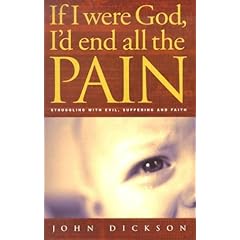 Why would a loving God allow so much suffering? All of us have wrestled with this question at some point. Almost every day as a pastor, I encounter people who are dealing with serious trials - people who may be asking this very question.
In the short book, If I Were God, I'd End All the Pain, John Dickson is not afraid to ask the question "Why?" In fact, he believes it's a healthy question that God Himself invites. The author shows that while there is still much mystery woven into our suffering, we can also be confident that Christianity provides the very best explanation for evil and suffering.
 , John Dickson is not afraid to ask the question "Why?" In fact, he believes it's a healthy question that God Himself invites. The author shows that while there is still much mystery woven into our suffering, we can also be confident that Christianity provides the very best explanation for evil and suffering.
After showing why suffering does not disprove God philosophically (ch. 1), the author explains how four alternative faiths attempt to explain suffering.
- Hinduism views suffering as karma, i.e. bringing balance for past wrongs.
- Buddhism, which actually developed from Buddha's quest to explain suffering, believes all suffering is just an illusion. It stems from a desire or affection for things of the world (e.g. comfort, health, money, love, etc.). If we can simply strip away these desires and enter a state of nirvana (non-existence), then suffering will cease.
- Islam believes all things are pre-determined by God, and that suffering is a direct result of Allah, the great "Unmoved Mover."
- Atheism endures suffering as the natural, unhappy by-product of our random, godless universe.
The author does not merely explain suffering, but provides three comforting truths that give hope and peace even in times of suffering:
- God will eventually judge and repay all the injustice in the world.
- God will eventually restore and re-create His world in perfection.
- By sending His Son to the cross, God Himself has suffered to the greatest degree, and through His suffering provides a substitute for us, so that we do not have to spend eternity apart from Him.
Wednesday, December 17, 2008
The blessings of nursing home ministry
Steve Burchett is a friend I met at the Founders Conference in Oklahoma in 2007. Then I amazingly ran into him again at Together for the Gospel in Kentucky in 2008. He has his own blog and is part of a great ministry called "Christian Communicators Worldwide," which is led by Jim Eliff.
Steve recently wrote an article on "Ten Reasons Why Nursing Homes are Great Places to Minister." Ministering in nursing homes can be difficult work, but it's a huge encouragement to ailing believers as well as an important final witness to the unsaved. It's easy for churches to overlook the homebound and infirm, yet Matthew 25:40 reminds us that when we serve even the least of Christ's brothers or sisters, we are serving Him.
Here's the list Steve came up with:
1. Nursing homes provide an avenue to obey God, Who tells us to serve the downcast and rejected.When's the last time you visited someone in the hospital or nursing home? I admit, the sights, sounds, and smells are not always pleasant, but it's a great opportunity to be a "Good Samaritan" and show the love of Christ to those who are suffering.
2. Nursing homes offer numerous opportunities for evangelism.
3. Nursing home residents will increase your trust in a sovereign God.
4. Nursing homes make available a place of real and life-impacting ministry for young men contemplating or heading into the ministry.
5. Nursing homes present a way to teach children to love their neighbor.
6. Nursing homes remind us that sickness and death are coming.
7. Nursing homes put you in the presence of older saints who are persevering in the Lord.
8. Nursing homes put you in the presence of people who have hardened their hearts, rejected Christ, and may never again have a coherent thought.
9. Nursing homes open doors to new relationships with those related to or associated with the residents.
10. Nursing homes provide a ministry environment where what really matters takes priority.
A nursing home ministry is something that a church can offically sponsor, or something that individual families can do by themselves on a weekly, monthly, or occasional basis. One thing's for sure - nursing home residents always love visitors!
Thursday, September 11, 2008
Where was God on September 11?
 Here on the west coast, many of us woke up seven years ago with the news that our country was under attack. I remember hearing a knock at the door, jumping out of bed, and being told by our neighbors that two jets had just crashed into the World Trade Center towers. We immediately turned on the radio (didn't have cable TV) to hear the description of the first tower collapsing "like a melting candle."
Later that morning at work, I stood in shock as I watched the replay again and again of United Flight 175 crashing into the south tower. It's still sends shivers up my spine: Four hijackings. Thousands killed. All flights cancelled. The dawning of a new war.
Where was God on September 11? Did He fall asleep or "step away from His desk" for a few minutes? Was He surprised by what happened? Did He try to prevent it and fail?
While September 11, 2001 was one of the darker moments in history, it doesn't disprove the existence of a sovereign God. God was firmly seated upon His throne when those terrorists first heard the concept of jihad as little boys. He watched them as they obtained their visas to enter the United States. He was sovereign as they attended flight school, then boarded their flights, then hijacked the planes, and finally steered them into the trade center and the Pentagon. He sees them even now as a holy God who executes His eternal justice (Rom. 12:19).
At any stage, God could have instantly put a stop to this horrible plot, if He had chosen to do so. "The LORD has established His throne in the heavens, and His sovereignty rules over all" (Ps. 103:19). But for reasons known only to Him, God permitted this evil scheme to be carried out.
The fact is, what happened on September 11 is just another example of what God observed several thousand years ago: "Then the LORD saw that the wickedness of man was great on the earth, and that every intent of the thoughts of his heart was only evil continually" (Gen. 6:5).
The terrorist attack seven years ago was a tragic example of human depravity, but it reveals a condition all of us share. It may have been more severe in degree, but it was identical in kind. You see, all of us sin and fall short of God's glory (Rom. 3:23). All of us have rebelled against God. Yet thankfully, God lovingly sent His Son Jesus to rescue us from this condition by paying for that sin once and for all upon the cross. This day and every day, that is very good news to remember.
Friday, August 22, 2008
Remember the prisoners
 "Remember the prisoners, as though in prison with them, and those who are ill-treated, since you yourselves also are in the body" (Hebrews 13:3)
One brother in Christ we can remember in prayer is Pastor "Bike" Mingxuan. Pastor "Bike," known for traveling thousands of miles across China on a bicycle to evangelize, was arrested by Chinese police just two days before the Olympics began. He was the inspiration behind a unique wrist band project which encouraged people to pray for China, and has resulted in more than 800,000 bands to be circulated. To learn more about the Olympic Prayer Band, click here.
According to Voice of the Martyrs, Pastor Bike and other Chinese evangelists had been repeatedly harassed by Chinese officials leading up to his arrest. Please pray for the release of Pastor Bike and his wife. And in this Olympic year, please remember the prisoners.
Wednesday, August 13, 2008
Persecution of Christ and the church
 On Sunday evening, August 3, I had the privilege of preaching at our former church, Placerita Baptist Church in Newhall, California. The topic for the night was "The Persecuted Work of Christ: The Painful Path to Glory." We looked together at Jesus' discourse in John 15 and noticed four facts about persecution:
1. The Promise of Persecution (Jn. 15:18-21)
2. The Pinnacle of Persecution (Jn. 15:18-21)
3. The Purpose of Persecution (Jn. 15:22-25)
4. The Paraclete of Persecution (Jn. 15:26-27)
Studying and preaching this passage really opened my eyes to the importance of Christ's persecution, the dark reality of persecution over twenty centuries of Christianity, and the tremendous value of the Holy Spirit in times of affliction.
You can download or listen to the sermon here.
Thursday, July 31, 2008
The poison of the therapeutic gospel
While scanning through Paul Marshall's book Their Blood Cries Out, I came across this excellent quote. It shows the poisonous nature of the therapeutic gospel and prosperity gospel in times of suffering. Marshall here sounds very similar to David Wells, and helps explain why so many American Christians are apathetic to global persecution today.
 , I came across this excellent quote. It shows the poisonous nature of the therapeutic gospel and prosperity gospel in times of suffering. Marshall here sounds very similar to David Wells, and helps explain why so many American Christians are apathetic to global persecution today.
Clearly, a positive outlook can have value in dealing with most of our ordinary day-to-day frustrations. But if God is always supposed to provide relief, then suffering Christians seem to make God appear untrustworthy and the product unreliable. Why hasn't Christianity "worked" for the Sudanese the way it does in America? How can the prayers of suffering Christians in Vietnam remain unanswered?
Historically, the heart of the evangelical gospel has been "Christ died for your sins," not the modern preoccupation "Christ died for your problems." If religious teaching becomes a promise of psychological benefits, then a seemingly logical conclusion is that suffering stems from a lack of faith...
But what does this mean for those who struggle against adversity, persecution, and poverty? If obedience is the key to the future, then they must somehow have failed, somehow have fallen short of God's best, somehow been disobedient. What does it say of the apostle Paul, writing letters from a prison cell, not to mention Jesus, who was markedly "unsuccessful." He found himself betrayed, abandoned, and hung on a cross.
These are not the only tendencies in evangelicalism. But they are the dominant ones. They are the themes that dominate the best-seller lists, the magazines, the TV shows, and all-too-many of the churches. The result is a faith that has its eyes turned resolutely inward.
Self-absorption is clearly not the only reason western evangelicals remain unconcerned about their persecuted counterparts across the sea. But it certainly contributes to the apathy. (pp. 155-56)
Wednesday, July 30, 2008
Update on Tom Ascol
Donna Ascol has finally written an update on her husband Tom, who was struck by lighting two weeks ago. You can read her message here. It sounds like Tom is making a slow and difficult - but steady - recovery. Please continue to keep him in your prayers.
I was convicted over my own lack of sensitivity toward the elderly and infirm as I read this paragraph:
I was convicted over my own lack of sensitivity toward the elderly and infirm as I read this paragraph:
We understand more about the mysteries of the human body and how many people suffer from real symptoms that cannot be viewed by casual observers. Even as Tom struggled through the airport, I wondered how many travelers were aware of his struggle. I doubt that those who were frustrated by his slow gait and halting steps stopped to consider what might be going on inside of him. I pray that God would help me to be more compassionate to those who struggle internally.
Subscribe to:
Posts (Atom)
New Blog
Today I'm closing up shop and launching a new blog called Pinch of Clay. You can visit it by clicking here . Please stop by and...

-
Heidi Amelia Jones was born at 3:11 this morning. She weighed in at 7 lbs., 4 oz., and is 20.25" long. Mama and baby are both doing wel...
-
 You may have noticed a change in the Bible I preach from. That's because, after testing the Holman Christian Standard Bible for almost a...
-
 I must admit, I still get confused by all those Herods mentioned in the New Testament. To keep them straight, I find it helpful to read the ...